“My child enjoys several subjects, but should they keep a broad programme or specialise in a few?” It’s the kind of question parents often ask when comparing the IB with the UK curriculum. Sev7n offers online tutoring for both IB and Cambridge AS & A Level students, helping learners receive personalised support tailored to their programme, subjects, and academic goals. With an experienced IB tuition in the UK, students can strengthen their subject knowledge, build confidence, and prepare more effectively for assessments and exams.
The IB provides an international framework that emphasises inquiry, interdisciplinary learning and independent research. The UK pathway varies by age and qualification: students usually study a broad range of subjects at GCSE, then specialise in fewer subjects for A Levels in England.
Neither route is automatically better. The right choice depends on your child’s strengths, interests, preferred learning style and future university plans. This guide compares the pathways to help your family decide which may suit your child.
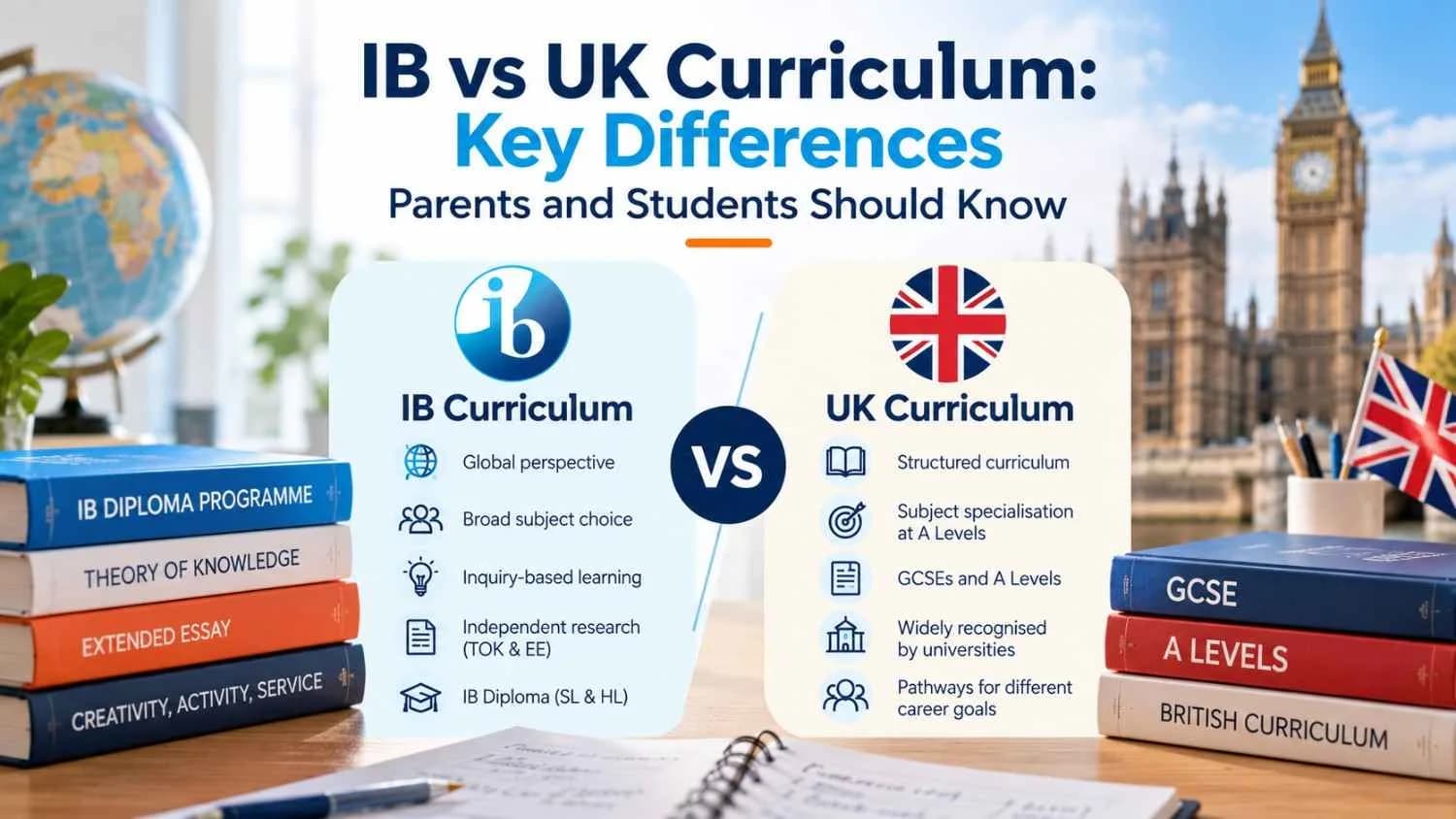
IB vs UK Curriculum: Key Differences at a Glance
Before comparing the two, it's important to understand that the UK does not have one uniform school curriculum. England, Scotland, Wales and Northern Ireland have different curriculum and qualification arrangements.
For a practical comparison, this guide primarily uses the English National Curriculum, GCSEs and A Levels, which are common reference points for parents comparing British-curriculum and IB schools internationally.
Feature | IB Curriculum | UK Curriculum (England) |
Educational structure | PYP, MYP, DP and CP | Primary and secondary education, commonly followed by GCSEs and A Levels |
Curriculum approach | Inquiry, conceptual understanding and international perspectives | Subject-specific learning with prescribed knowledge and skills |
Typical age range | IB programmes serve students aged 3–19 | Primary and secondary education, followed by post-16 qualifications |
Subject choice at ages 16–18 | DP students normally study six subjects and the DP core | A Level students commonly take three subjects, sometimes four |
Assessment | Depends on programme; DP uses examinations and internal assessments | GCSEs and A Levels use subject-specific assessments, predominantly examinations |
Independent research | DP includes an Extended Essay and Theory of Knowledge | Research opportunities vary; some students take an EPQ |
Final qualification | IB Diploma, for students completing the DP | A Levels or other recognised post-16 qualifications |
University recognition | Recognised by universities internationally | A Levels are widely recognised internationally |
A particularly important distinction is that the IB Diploma and A Levels are qualifications, whereas the English National Curriculum is a school curriculum framework. Comparing the IB Diploma directly with the National Curriculum would therefore mix two different stages of education.
What Is the IB Curriculum?
The International Baccalaureate is an educational framework designed for students aged 3–19. It encourages learners to investigate questions, connect knowledge across subjects and consider different perspectives.
The IB offers four programmes:
Primary Years Programme (PYP): Generally for children aged 3–12, with inquiry-based learning across subject areas.
Middle Years Programme (MYP): For students aged 11–16, connecting academic subjects with real-world contexts.
Diploma Programme (DP): A two-year pre-university programme for students aged 16–19.
Career-related Programme (CP): For students aged 16–19 who want to combine academic study with career-related learning.
Schools may offer one or several IB programmes. Attending an IB World School does not necessarily mean a student will complete the entire IB pathway.
How Does the IB Diploma Programme Work?
The IB Diploma Programme requires students to study subjects from six groups:
Studies in Language and Literature
Language Acquisition
Individuals and Societies
Sciences
Mathematics
The Arts
Students may select an additional subject from certain other groups instead of an arts subject, subject to the programme's rules.
They normally take three subjects at Higher Level (HL) and three at Standard Level (SL), although four HL subjects are permitted.
Alongside these subjects, students complete three core components:
Theory of Knowledge (TOK) examines how knowledge is developed, justified and evaluated.
Extended Essay (EE) is an independent research project culminating in a paper of up to 4,000 words.
Creativity, Activity, Service (CAS) encourages students to participate in experiences beyond academic study and reflect on their learning.
This combination is intended to develop both subject knowledge and broader academic skills.
Parents exploring the Diploma Programme can also review SEV7N's IBDP curriculum and subject support.
What Is the UK School Curriculum?
The term UK curriculum is often used by international schools to describe a British-style education leading to GCSEs, IGCSEs and A Levels.
However, the precise curriculum depends on the school and the awarding bodies it uses.
In England, the National Curriculum specifies subjects and standards for different stages of education. It is organised into four key stages.
Key stage | Typical age | School years |
Key Stage 1 | 5–7 | Years 1–2 |
Key Stage 2 | 7–11 | Years 3–6 |
Key Stage 3 | 11–14 | Years 7–9 |
Key Stage 4 | 14–16 | Years 10–11 |
At Key Stage 4, students commonly work towards GCSE qualifications.
After Year 11, students may continue with A Levels, vocational qualifications or other approved programmes.
The Department for Education's National Curriculum guidance explains the structure and subject requirements in England.
GCSEs and IGCSEs: Are They the Same?
GCSEs and International GCSEs (IGCSEs) are qualifications typically taken around ages 14–16.
They cover broadly comparable stages of education, but the syllabuses, assessment structures and awarding bodies can differ.
IGCSEs are commonly offered by international schools outside the UK, although some schools within the UK also offer them.
Parents should check the exact qualification and examination board rather than assuming all British-curriculum schools follow identical courses.
What Are A Levels?
A Levels are subject-based qualifications usually studied over two years, typically between ages 16 and 18.
Most students select three subjects, although some take four.
For example, a student interested in engineering might choose Mathematics, Further Mathematics and Physics.
A student interested in economics might choose Mathematics, Economics and another relevant subject.
This allows considerable subject specialisation before university.
However, subject choice matters. Some university degrees require particular A Level subjects, so students should investigate entry requirements before making their selections.
IB vs UK Curriculum: How Do Teaching and Learning Differ?
The way students learn can be just as important as the subjects they study.
Both IB and British-curriculum schools can provide excellent teaching, but their educational frameworks encourage different approaches.
Learning in the IB Curriculum
IB programmes emphasise inquiry, reflection and applying knowledge to unfamiliar situations.
For example, a student studying climate change might examine scientific evidence, economic consequences and ethical questions across different subjects.
In the Diploma Programme, students also develop independent research skills through the Extended Essay and examine questions about knowledge through TOK.
This does not mean IB students avoid textbooks or examinations. Subject knowledge remains essential, particularly in the Diploma Programme.
Learning in the UK Curriculum
The English National Curriculum establishes subject knowledge and skills that students should develop at different ages.
At GCSE and A Level, students work towards qualifications with defined subject specifications.
A Level students generally spend more time studying fewer subjects, which can provide an opportunity to develop substantial depth in their chosen areas.
For example, a student taking A Level Mathematics, Further Mathematics and Physics can concentrate heavily on mathematical and scientific study without also having to complete a language or humanities subject at that stage.
The teaching approach still depends considerably on the school and teacher. British-curriculum schools can use inquiry, practical projects and independent research too.
IB vs A Levels: Which Has a Heavier Workload?
The IB Diploma generally requires students to manage a broader range of subjects and compulsory core activities. A Levels usually involve fewer subjects, but each may require considerable depth.
Consider two hypothetical students interested in engineering.
Student A chooses the IB Diploma. They study Mathematics and Physics at Higher Level, alongside their other required subjects. They must also manage TOK, the Extended Essay and CAS.
Student B chooses A Levels. They study Mathematics, Further Mathematics and Physics, concentrating their timetable on those three subjects.
Student A has more distinct academic and core commitments. Student B may spend more time on advanced mathematical material.
Neither student's workload is necessarily easier. The challenge depends on subject choices, assessment requirements, personal strengths and time management.
For IB students taking demanding Higher Level subjects, targeted support can help address specific difficulties. For example, students working through calculus or advanced algebra can explore IB Mathematics AA tutoring alongside their school lessons.
How Are Students Assessed in IB and the UK Curriculum?
Assessment is another important difference between the IB Diploma and GCSE/A Level pathways.
IB Diploma Grading
Each IB Diploma subject is graded from 1 to 7, with 7 being the highest.
Six subjects can contribute a maximum of 42 points. TOK and the Extended Essay can contribute up to three additional points, making the maximum Diploma score 45.
Students must earn at least 24 points and satisfy additional conditions to receive the Diploma. CAS completion is required but does not add points.
The Diploma combines external examinations with internally assessed work in many subjects. The balance varies by subject.
GCSE and A Level Grading
In England, GCSEs use grades 9–1, with 9 being the highest.
A Levels use grades A* to E for passing grades.
GCSE and A Level assessment arrangements depend on the qualification and subject. Written examinations play a major role, although some subjects include practical assessments or non-examined components.
The UK's qualifications regulator, Ofqual, explains how GCSE and A Level grading works.
Important: An IB score of 7 should not be treated as directly equivalent to an A Level A* in every admissions situation. Universities apply their own qualification and subject requirements.
IB vs UK Curriculum: Which Is Better for University Admissions?
Both the IB Diploma and A Levels can provide routes to universities in the UK and internationally.
The more important question is whether a student's qualifications, subject choices and predicted or achieved grades meet the requirements of their intended degree.
Applying to UK Universities with the IB Diploma
UK universities commonly publish entry requirements for IB Diploma applicants alongside A Level requirements.
Some courses specify an overall Diploma score as well as minimum grades in particular Higher Level subjects.
For example, a university engineering course may require specific Mathematics and Physics qualifications. An IB student must check whether the course accepts Mathematics: Analysis and Approaches, Mathematics: Applications and Interpretation, or both, and at which level.
Similarly, a medicine course may have specific requirements for Chemistry and Biology.
Students should check each university's official course page rather than rely on general statements that one qualification is more widely accepted.
Applying with A Levels
A Level applicants are typically assessed using the grades and subjects required for their chosen course.
A student applying for a degree that requires Mathematics may not be eligible simply because they have three strong A Level grades in unrelated subjects.
Subject selection therefore matters in both pathways.
Does the IB Give Students an Advantage at University?
There is no universal admissions advantage attached to the IB Diploma.
Its breadth, research requirements and academic structure may suit certain students well, but universities evaluate applicants against their published admissions criteria.
An excellent A Level application can be stronger than a weaker IB application, and the reverse can also be true.
The best preparation is to choose subjects that meet entry requirements and give the student a realistic opportunity to perform well.
IB vs UK Curriculum: Which Is Better for Students in India?
For Indian families considering international schools, the decision often involves comparing IB programmes with British-curriculum schools offering IGCSEs and A Levels.
Parents should consider where their child is likely to study at university, which subjects they enjoy and whether the family may relocate internationally.
When the IB May Be a Suitable Choice
The IB may appeal to students who:
Enjoy studying several academic disciplines.
Are interested in independent research and interdisciplinary learning.
Want to maintain a broad subject combination until the end of school.
Are comfortable balancing coursework, examinations and extracurricular commitments.
When the British Curriculum May Be a Suitable Choice
A British-curriculum pathway may appeal to students who:
Prefer specialising in fewer subjects during their final school years.
Already have a reasonably clear university direction.
Want a qualification structure centred on GCSEs or IGCSEs followed by A Levels.
Prefer focusing their study time on a smaller number of academic subjects.
Neither curriculum guarantees admission to an Indian or overseas university.
Families considering undergraduate study in India should verify the current recognition, equivalence and subject requirements of their intended institutions, especially for regulated professional courses.
Can Students Switch from the UK Curriculum to IB?
Yes. Students can move from GCSEs or IGCSEs into the IB Diploma, provided they meet the admitting school's entry requirements.
The transition may require some adjustment because the IB Diploma has broader subject requirements and compulsory core components.
For example, a student who planned to concentrate entirely on Mathematics, Physics and Chemistry at A Level would need to study additional subject groups in the IB Diploma.
When Should Students Consider an IB Tutor in the UK?
Moving from GCSEs or IGCSEs to the IB Diploma can take some adjustment. Students need to manage six subjects alongside Theory of Knowledge (TOK), the Extended Essay and Creativity, Activity, Service (CAS).
An IB tutor in the UK can help students who need additional support with Higher Level subjects, examination techniques or difficult syllabus topics. Online tutoring can also be useful for students preparing for IB assessments while balancing schoolwork and coursework deadlines.
For example, students struggling with advanced mathematics can explore IB Mathematics AA tutoring, while those who need help with scientific concepts can consider IB Chemistry tutoring.
The right support should address the student's specific learning gaps rather than simply repeat classroom lessons.
What Should Students Prepare for Before Switching?
Students should check their prospective school's subject offerings and entry requirements, particularly for Higher Level subjects.
They should also consider:
Whether they can meet the language requirements.
Which Mathematics course best supports their university plans.
How they will manage six subjects and the DP core.
Whether they are comfortable with independent research and internally assessed coursework.
Whether their previous study has prepared them for the subjects they want to take at HL.
A student moving from IGCSE to IB Chemistry HL, for example, should review foundational chemical calculations and concepts before beginning the course.
Students who need subject-specific support can explore SEV7N's IB Diploma Programme tutoring, which covers subjects at Standard and Higher Level.
How to Choose Between IB and the UK Curriculum
Rather than deciding which curriculum sounds more prestigious, parents can use the following questions to guide their choice.
Question | Why it matters |
Does your child prefer a broad range of subjects or early specialisation? | IB DP requires broader subject coverage; A Levels permit greater specialisation |
Which university courses are they considering? | Some degrees require particular subjects and levels |
How does your child manage multiple deadlines? | IB DP includes examinations, research and core commitments |
Which schools offer the strongest teaching in the relevant subjects? | School quality and subject availability can matter as much as curriculum choice |
Is the family likely to relocate? | School availability and continuity should be considered |
What academic support will be available? | Support needs vary with the student and subject combination |
For a student who enjoys literature, sciences and languages and wants to keep several university options open, the IB Diploma may be appealing.
For a student with a clear interest in a mathematics-intensive degree who wants to focus on a smaller set of subjects, A Levels may be more suitable.
These are illustrations, not fixed rules. Individual subject combinations and school provision can change the answer.
Frequently Asked Questions About IB vs UK Curriculum
1. What is the main difference between the IB and UK school curriculum?
The IB offers internationally designed programmes with an emphasis on inquiry, conceptual learning and international perspectives. The English National Curriculum specifies learning expectations at different school stages, while GCSEs and A Levels provide subject-based qualifications. At ages 16–18, the IB Diploma requires broader subject coverage than a typical A Level programme.
2. Is IB harder than the British curriculum?
Neither is universally harder. The IB Diploma requires six subjects and three core components, while A Level students typically study fewer subjects in greater depth. Difficulty depends on the subjects selected, assessment demands and individual strengths.
3. Is the IB Diploma equivalent to A Levels?
Both are recognised pre-university qualifications, but they have different structures and grading systems. Universities publish separate requirements for IB and A Level applicants rather than treating their grades as automatically interchangeable.
4. Can IB students apply to universities in the UK?
Yes. UK universities accept IB Diploma qualifications where they meet the institution's course-specific entry requirements. Students should check overall points, Higher Level subject requirements and any additional admissions conditions.
5. Can students study IGCSE and then switch to IB?
Yes. Many students progress from IGCSEs to the IB Diploma. Admission depends on the school's requirements and whether the student has sufficient preparation for their intended SL and HL subjects.
6. Which is better for studying medicine: IB or A Levels?
Both can be suitable for medicine. The important factors are meeting the university's required science subjects, levels and grades, alongside any admissions tests or other selection criteria. Students should check individual medical school requirements before choosing subjects.
7. Does the IB curriculum include GCSEs?
No. GCSEs are separate qualifications. Some schools offer GCSEs or IGCSEs before students enter the IB Diploma, but GCSEs are not a compulsory component of the IB framework.
8. Is the UK curriculum the same as the British curriculum?
The terms are often used interchangeably by international schools, but they are not precise equivalents. The UK has different education systems across its constituent nations, while a school advertising a British curriculum may specifically offer English-style education with IGCSEs and A Levels.
Final Thoughts: IB or UK Curriculum?
The choice between IB and the UK curriculum should begin with the student, not the reputation of a qualification.
The IB Diploma offers a broad academic programme with research and reflective learning built into its structure. The A Level pathway generally offers more opportunity to specialise in selected subjects.
Both can lead to excellent university opportunities when students choose suitable subjects and meet the relevant entry requirements.
For families considering the IB pathway, SEV7N provides online IB tutoring and academic support across Diploma Programme subjects. Students can use this support to strengthen subject understanding, prepare for examinations and develop their own research and analytical skills.