“My child knows the business terms, but can they use them to explain a real company’s decisions?” That’s the kind of question one IB parent might ask another while exams are approaching. Sev7n offers one-to-one online IB Business Management tuition with active IB Examiners, including practice with case studies, business tools and exam-style questions.
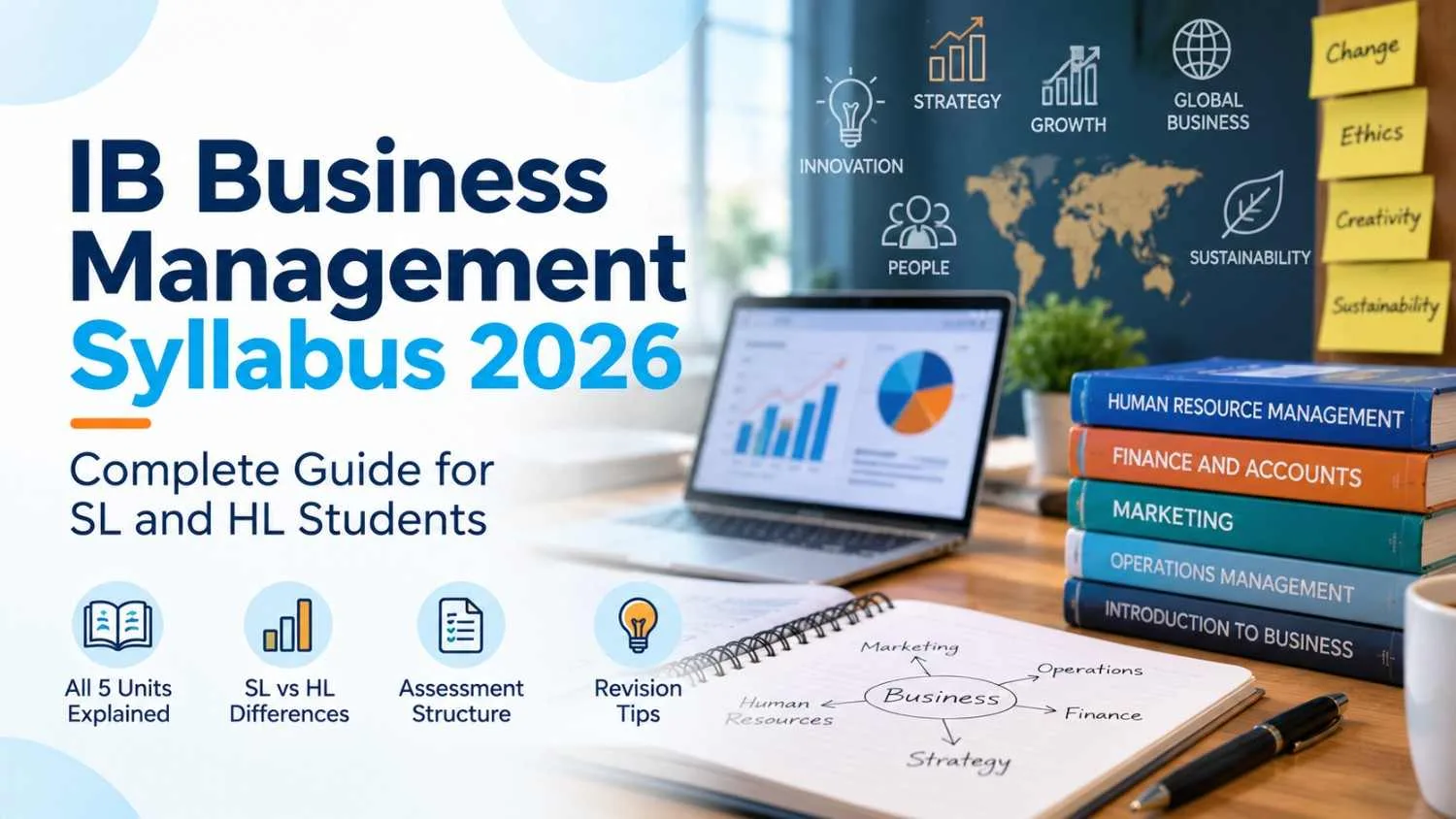
The 2026 syllabus covers five units: Introduction to Business Management, Human Resource Management, Finance and Accounts, Marketing, and Operations Management. SL and HL students study these areas, while HL includes additional topics, more teaching hours and a third examination paper.
The course is about more than learning business definitions. Students need to understand why organisations make certain decisions, apply financial and strategic tools, and evaluate the effects on different stakeholders. This guide explains the syllabus, SL and HL differences, assessment structure, Internal Assessment (IA) and practical ways to revise for the May or November 2026 exams.
What Is the IB Business Management Syllabus for 2026?
IB Business Management is a subject within the Individuals and Societies group of the International Baccalaureate Diploma Programme (IBDP).
The course explores how organisations operate, make decisions and respond to changing business conditions. Students examine real business situations involving employees, customers, finance, marketing, production and strategy.
The current syllabus was introduced for first assessment in 2024 and remains the basis of the 2026 examination sessions. It is organised around five units and four key concepts: change, creativity, ethics and sustainability.
Unit | Main focus | Examples of what you'll study |
Unit 1: Introduction to Business Management | How businesses operate | Business objectives, stakeholders, growth and external influences |
Unit 2: Human Resource Management | Managing people | Leadership, motivation, organisational structures and communication |
Unit 3: Finance and Accounts | Financial decision-making | Costs, revenue, cash flow, accounts and investment appraisal |
Unit 4: Marketing | Reaching and retaining customers | Market research, segmentation, pricing and promotion |
Unit 5: Operations Management | Producing goods and services | Production methods, quality, location and operational efficiency |
Students also learn to apply the Business Management Toolkit, which contains analytical methods used to examine business problems and recommend possible solutions.
You can refer to the official IB Business Management guide for the detailed syllabus statements and assessment requirements.
IB Business Management SL vs HL: What's the Difference?
Both SL and HL students develop an understanding of business functions and decision-making. The main difference is the depth of content and assessment.
Feature | Standard Level (SL) | Higher Level (HL) |
Recommended teaching hours | 150 hours | 240 hours |
Main syllabus | Five units, excluding HL-only content | Five units, including HL extensions |
Key concepts | Change, creativity, ethics, sustainability | Same four concepts |
External examinations | Paper 1 and Paper 2 | Paper 1, Paper 2 and Paper 3 |
Internal Assessment | Business research project | Business research project |
IA weighting | 30% | 20% |
External assessment weighting | 70% | 80% |
The IB recommends 90 additional teaching hours for HL. These hours allow students to study more advanced business topics and develop the skills needed for HL-specific assessment.
Which level should you choose?
SL may suit students who want to understand business management while concentrating more heavily on other HL subjects.
HL may suit students with a strong interest in business, management, entrepreneurship or related university courses. However, choosing HL does not automatically provide an admissions advantage. Always check the entry requirements of your intended universities.
Complete IB Business Management Topics for SL and HL
The following sections explain the five IB Business Management units and the knowledge students are expected to develop.
Unit 1: Introduction to Business Management
This unit explains why businesses exist, how they are organised and what influences their decisions.
It forms the foundation for the rest of the syllabus because business objectives, stakeholders and external pressures appear in questions across several units.
Topics covered
1.1 What is a business?
1.2 Types of business entities
1.3 Business objectives
1.4 Stakeholders
1.5 Growth and evolution
1.6 Multinational companies (MNCs)
What should students understand?
You'll examine the differences between private and public sector organisations, profit-making businesses and non-profit organisations. You'll also learn why business objectives may change over time.
For example, a new company may initially focus on survival and building a customer base. Once established, it may prioritise profitability, market share or expansion into new markets.
These decisions can affect employees, shareholders, customers and the wider community differently.
Example: Imagine a growing Indian food delivery company considering expansion into Singapore. Management would need to evaluate market demand, competition, costs, regulations and potential risks before deciding whether expansion is worthwhile.
A strong Business Management answer would not simply say that international expansion increases sales. It would consider whether the potential benefits justify the investment and operational risks.
What should you practise?
Focus on explaining how business objectives influence decisions and how different stakeholder groups may respond to those decisions.
You should also be able to apply business growth strategies to specific organisations rather than describe them in isolation.
Unit 2: Human Resource Management
Human Resource Management (HRM) examines how businesses recruit, organise, motivate and retain employees.
This unit helps you understand how decisions about people can influence productivity, workplace culture and long-term performance.
Topics covered
2.1 Introduction to human resource management
2.2 Organisational structure
2.3 Leadership and management
2.4 Motivation and demotivation
2.5 Organisational (corporate) culture — HL
2.6 Communication
2.7 Industrial/employee relations — HL
What makes this unit important?
Businesses depend on employees to deliver products and services, but different management approaches can produce different outcomes.
For example, a company with a centralised organisational structure may maintain tighter control over decisions. However, employees working directly with customers might have less flexibility to solve problems independently.
You'll study how leadership styles, motivation theories, organisational structures and communication influence business performance.
At HL, you'll examine organisational culture and employee relations in greater depth.
Example of an exam-style question
Evaluate whether financial incentives are the most effective way to motivate employees in a technology company.
A strong response would consider the benefits of financial rewards alongside other factors, such as job satisfaction, career development, recognition and working conditions.
The conclusion should reflect the particular business situation rather than assume that one motivation method works equally well for every employee.
Unit 3: Finance and Accounts
Finance and Accounts is one of the most calculation-intensive parts of the IB Business Management syllabus. You'll learn how businesses raise money, manage costs, interpret financial information and make investment decisions.
Topics covered
3.1 Sources of finance
3.2 Costs and revenues
3.3 Break-even analysis
3.4 Final accounts, including HL-only content
3.5 Profitability and liquidity ratio analysis
3.6 Efficiency ratio analysis — HL
3.7 Cash flow
3.8 Investment appraisal, including HL-only content
3.9 Budgets — HL
Key financial concepts students should understand
Concept | What it helps a business determine |
Break-even analysis | The sales volume needed to cover total costs |
Cash flow forecasting | Whether sufficient cash may be available to meet payments |
Profitability ratios | How effectively a business generates profit |
Liquidity ratios | Whether a business can meet short-term financial obligations |
Investment appraisal | Whether a proposed investment is financially attractive |
Budgets | How financial resources can be planned and controlled |
Worked example: Break-even analysis
Suppose a business sells reusable water bottles with the following costs:
Selling price per bottle: ₹500
Variable cost per bottle: ₹300
Monthly fixed costs: ₹40,000
The break-even formula is:

The business needs to sell 200 bottles to cover its total costs under these assumptions.
However, calculating break-even output is only the first step.
An IB exam question might ask whether the business should reduce its selling price to increase sales. You would need to consider how that decision changes the contribution per unit, the break-even point, demand and profitability.
This is where mathematical accuracy and business judgement work together.
Unit 4: Marketing
Marketing examines how businesses understand customers, develop products, set prices and communicate value.
It's particularly useful for understanding why a successful product in one market may struggle in another.
Topics covered
4.1 Introduction to marketing
4.2 Marketing planning
4.3 Sales forecasting — HL
4.4 Market research
4.5 The seven Ps of the marketing mix
4.6 International marketing — HL
What will you learn?
You'll explore how businesses identify their target markets and position their products against competitors.
The seven Ps of the marketing mix are:
Product
Price
Place
Promotion
People
Processes
Physical evidence
You should understand how these elements work together rather than treat them as unrelated definitions.
Practical example
Consider a premium skincare company planning to enter the Indian market.
It may need to investigate customer preferences, purchasing power, competing brands and distribution channels.
A high price could support premium positioning, but it might also limit the number of customers willing to purchase the product.
In an examination, you could be asked to recommend a pricing or promotional strategy using the case study evidence.
A good recommendation would explain why the proposed approach suits the company's objectives, resources and target customers.
At HL, students also examine international marketing decisions and the challenges of operating across different markets.
Unit 5: Operations Management
Operations Management focuses on how businesses produce goods and deliver services efficiently while maintaining appropriate quality.
This unit connects closely with finance, HRM and marketing because production decisions affect costs, employees and customer satisfaction.
Topics covered
5.1 Introduction to operations management
5.2 Operations methods
5.3 Lean production and quality management — HL
5.4 Location
5.5 Production planning — HL
5.6 Research and development — HL
5.7 Crisis management and contingency planning — HL
What should students understand?
You'll examine different production methods and the factors businesses consider when selecting them.
For example, a small furniture company producing customised tables may prefer job production because each order has different requirements.
A large manufacturer producing thousands of identical tables may find flow production more suitable.
Neither method is universally better. The appropriate choice depends on production volume, customer requirements, available capital and flexibility.
HL students explore additional areas such as lean production, quality management, research and development, and contingency planning.
Example of a business decision
A manufacturer experiences repeated delays because a supplier cannot deliver materials on time.
Management might consider holding additional inventory, changing suppliers or modifying production schedules.
Each option has costs and risks. In an IB Business Management response, you should explain those trade-offs and justify which option is most appropriate for the organisation.
What Is the IB Business Management Toolkit?
The Business Management Toolkit is a collection of analytical tools and techniques that students use to investigate business situations, interpret evidence and support decisions.
The toolkit is integrated into the syllabus rather than assessed as a separate unit.
Some particularly useful tools include:
Business tool | Purpose | Example application |
SWOT analysis | Identifies strengths, weaknesses, opportunities and threats | Evaluating a company's competitive position |
Ansoff matrix | Examines business growth strategies | Deciding between market penetration and diversification |
STEEPLE analysis | Evaluates external influences | Assessing political, economic and technological changes |
Decision trees | Compares possible decisions using probabilities and outcomes | Evaluating alternative investment options |
Break-even analysis | Calculates the output required to cover costs | Assessing the viability of a new product |
Boston Consulting Group (BCG) matrix | Analyses a product portfolio | Deciding which products may need further investment |
Force field analysis | Examines forces supporting and resisting change | Evaluating a proposed organisational restructuring |
Not every tool is prescribed at both levels. Students should check the SL/HL designation and any specific requirements in the official IB guide.
How do you use business tools effectively in an exam?
Simply drawing a SWOT analysis or Ansoff matrix is rarely enough.
Suppose a company is considering launching a new product in an existing market. The Ansoff matrix would identify this as product development.
You would then need to explain the implications, such as research and development costs, potential demand, competition and the risk of the product failing.
The tool supports the analysis; it does not replace the reasoning.
IB Business Management Assessment Structure in 2026
The 2026 assessment includes external examinations and an internally assessed business research project.
SL students take two examination papers, while HL students take three.
Assessment | SL weighting | HL weighting |
Paper 1 | 35% | 25% |
Paper 2 | 35% | 30% |
Paper 3 | Not applicable | 25% |
Internal Assessment | 30% | 20% |
Total | 100% | 100% |
These weightings follow the IB Business Management guide for first assessment in 2024, which remains applicable to the 2026 course.
IB Business Management Paper 1: Case Study Analysis
Paper 1 is based on a case study that students encounter in the examination, with limited contextual material released in advance.
The pre-release provides a starting point for research and familiarisation, but students do not receive the complete examination case study beforehand.
Paper 1 assesses your ability to apply business knowledge to a particular organisation and its circumstances.
To prepare effectively:
Study the pre-release material and research the specified contextual topics.
Review relevant syllabus concepts and business tools.
Practise using evidence from case studies in your explanations.
Learn to distinguish between describing a problem and evaluating possible solutions.
Avoid preparing memorised answers based on predictions. The examination can ask questions that require you to apply knowledge in ways you haven't rehearsed.
IB Business Management Paper 2: Quantitative and Qualitative Analysis
Paper 2 assesses your ability to interpret unfamiliar business information, complete calculations and explain business decisions.
Financial calculations are particularly important, but numerical accuracy alone is not enough.
For example, you may calculate a company's liquidity ratio and then be asked to explain what it suggests about the business's ability to meet short-term obligations.
You need to interpret the result in the context of the organisation rather than merely reproduce the formula.
Students should practise calculations, business terminology, data interpretation and written evaluation under timed conditions.
IB Business Management Paper 3: HL Only
Paper 3 is a Higher Level assessment based on an unseen social enterprise scenario.
It requires students to interpret information, apply relevant business knowledge and develop a reasoned response to the organisation's challenges.
The paper tests your ability to combine ideas from different parts of the syllabus.
For example, a social enterprise may need to improve its financial sustainability while maintaining its social mission. Your response could involve finance, marketing, human resources and operations.
The strongest recommendations consider the organisation's objectives, constraints and stakeholders, rather than focusing only on profit.
IB Business Management Internal Assessment (IA) 2026
The IB Business Management IA is an individual business research project completed by both SL and HL students.
Students investigate a real business issue or problem through one of four conceptual lenses:
Change
Creativity
Ethics
Sustainability
The project requires the use of supporting documents and relevant business management tools or theories.
The report has a maximum word count of 1,800 words, and students use three to five supporting documents. The IA is assessed against criteria covering the integration of the key concept, supporting documents, tools and theories, analysis and evaluation, conclusions and report structure.
The IB's 2026 examiner instructions also clarify that supporting documents must meet the prescribed recency requirements.
How do you choose a good IB Business Management IA topic?
Start with a genuine business decision or problem that you can investigate using reliable evidence.
For example, a hypothetical research question could be:
To what extent should a local café introduce online delivery to increase its revenue?
This question provides opportunities to examine financial costs, potential demand, marketing, operational capacity and the implications of change.
However, you would need access to appropriate supporting evidence to answer it convincingly.
Before choosing a research question, check whether:
The question is specific enough to investigate within the word limit.
The business issue is genuine and relevant.
Suitable supporting documents are available.
You can apply appropriate business tools and theories.
The research allows you to reach a supported, balanced conclusion.
Your IA should not simply describe what a company does. It should investigate a meaningful business question and use evidence to develop a justified answer.
Teachers and tutors can help students understand the criteria, select suitable research methods and improve their analytical skills, but the investigation and submitted writing must remain the student's own work.
How to Prepare for IB Business Management Exams in 2026
Business Management revision works best when you combine subject knowledge with regular application.
Reading a textbook may help you understand concepts, but examination questions often require you to use those concepts to solve unfamiliar problems.
1. Build your understanding of all five units
Start by identifying which topics you understand and which need further attention.
For each topic, make sure you can explain the concept, recognise when it is relevant and apply it to a business example.
For instance, don't stop at defining economies of scale. Practise explaining when growth could reduce average costs and when expansion might introduce new management problems.
2. Learn the command terms
The wording of an examination question tells you what kind of response is required.
Command term | What your answer should do |
Define | Give the precise meaning of a term |
Explain | Provide reasons or show how something works |
Analyse | Break down an issue and explain relationships or implications |
Discuss | Consider different aspects of an issue using reasoned arguments |
Evaluate | Weigh strengths, limitations and consequences to reach a supported judgement |
Recommend | Propose a justified course of action |
Pay particular attention to questions that require evaluation. These demand more than a list of advantages and disadvantages.
3. Practise finance calculations alongside interpretation
For Finance and Accounts, revise the formulas and practise applying them to realistic business situations.
After each calculation, ask yourself what the result tells you.
A low liquidity ratio, for example, may indicate short-term financial pressure. However, the interpretation depends on the company's industry, operating cycle and other financial information.
4. Use real businesses to understand concepts
Business news and company reports can help you connect classroom learning to actual decisions.
For example, you could examine how an Indian retail business responds to online competition or how a manufacturer manages rising production costs.
Use these examples to strengthen your understanding, but remember that exam answers must respond to the evidence and circumstances in the question.
5. Practise timed examination questions
Allocate time to the different papers according to your level.
Review completed answers using the appropriate mark schemes and assessment criteria. Identify whether marks were lost because of missing knowledge, weak application, insufficient analysis or an unsupported conclusion.
Four-Week IB Business Management Revision Plan
This illustrative plan is intended for students who have already covered the syllabus and are preparing for their examinations.
Week | Topics to revise | Practice focus |
Week 1 | Unit 1 and Unit 2 | Business objectives, stakeholders, leadership, motivation and case-study questions |
Week 2 | Unit 3 | Financial calculations, ratio interpretation, cash flow and investment decisions |
Week 3 | Unit 4 and Unit 5 | Marketing strategies, operations, production decisions and evaluation |
Week 4 | All five units and the toolkit | Timed Paper 1 and Paper 2 practice; Paper 3 for HL students |
HL students should include additional HL-only content throughout the revision period rather than leaving it until the end.
Use your performance in practice questions to decide which topics need more time.
Frequently Asked Questions About the IB Business Management Syllabus 2026
1. How many units are there in IB Business Management?
There are five units: Introduction to Business Management, Human Resource Management, Finance and Accounts, Marketing, and Operations Management. Both SL and HL students study these units, but HL includes additional content.
2. Has the IB Business Management syllabus changed for 2026?
The 2026 examinations follow the Business Management course introduced for first assessment in 2024. This syllabus includes four key concepts, a business research project for both SL and HL, and a third examination paper for HL students.
3. Is IB Business Management HL harder than SL?
HL has a greater syllabus workload, more advanced content and an additional examination paper. Whether a student finds it more difficult depends on their strengths in analysis, calculations, writing and applying business concepts.
4. Is there a Paper 3 in IB Business Management SL?
No. Paper 3 is assessed only at Higher Level. Standard Level students take Paper 1 and Paper 2, alongside their Internal Assessment.
5. What is the word limit for the IB Business Management IA?
The current IA research project has a maximum word count of 1,800 words for both SL and HL students. It must investigate a real business issue using relevant supporting documents and business management concepts.
6. Do I need to be good at Maths for IB Business Management?
You need to be comfortable with calculations involving costs, revenues, break-even analysis, cash flow and financial ratios. However, the course also places considerable emphasis on written analysis, interpretation and business judgement.
7. Can I get a 7 in IB Business Management by memorising the textbook?
Memorising definitions alone is unlikely to be sufficient for the highest grade. Students must apply concepts to case studies, interpret evidence, use business tools correctly and justify their conclusions.
8. What is the best way to prepare for IB Business Management Paper 1?
Understand the pre-release context, revise relevant business concepts and practise answering unfamiliar case-study questions. Avoid relying entirely on predicted questions or memorised responses.
Need Help with IB Business Management SL or HL?
If you're struggling with financial calculations, case-study analysis, extended-response questions or the HL Paper 3, identify the specific skills that need improvement before planning your revision.
SEV7N offers IB Business Management tutoring for SL and HL students, including support with syllabus topics, examination technique and understanding the IA requirements.
Students who need help across multiple Diploma Programme subjects can also explore SEV7N's IBDP tutoring programmes.
A useful starting point is to review the five syllabus units, complete a timed practice assessment and use the results to create a focused study plan for your 2026 examinations.